December 1: Rosa Parks Is Arrested (1955)
Prayer Idea
Pray for people who are standing up (or sitting down) for their convictions.
History Note
During the 1940s and 50s, African American residents of Montgomery, Alabama, suffered mistreatment as they tried to ride the local bus system. Raymond and Rosa Parks, who lived in Montgomery, had a long history of civil rights activism.
On March 2, 1955, Claudette Colvin, age 15, was going home from Booker T. Washington High School in Montgomery, Alabama. When the driver told Colvin to move because of the color of her skin, she refused. Two police officers pulled her off the bus and arrested her. Colvin maintained that she did not resist them.
Civil rights activists, including Rosa Parks, hoped that Colvin’s act of resistance would encourage other people in Montgomery to work for change. Colvin was found guilty of assaulting the officers, but the judge threw out the charge of breaking Alabama’s laws allowing segregation on public transportation. Thus Colvin’s case could not be appealed to challenge the segregation law.
Rosa Parks continued to mentor Claudette Colvin that year and encouraged her to share her experience. On December 1, Rosa Parks followed Colvin’s example and took a stand by sitting down.
As Rosa Parks was riding home from work, the bus she was on filled up. A white man was left standing without a seat. The driver asked four black passengers to stand up so that one white man could sit down. Three of the people in Parks’s row reluctantly got up, but Parks refused. She later recalled, “I felt that if I did stand up, it meant that I approved of the way I was being treated, and I did not approve.”
Police officers arrived to arrest Parks and took her to jail. She was released on bail later that evening. After reflecting on the situation, Rosa and Raymond Parks agreed to work with the NAACP and other organizations to use her case to challenge Alabama’s laws allowing segregation.
Local black leaders met the next night to organize a boycott of the city’s bus system. For a year, black residents in Montgomery walked, carpooled, and found other ways to get around while the bus system (which was a private company) lost money.
Finally, in November of 1956, the U.S. Supreme Court upheld a lower court ruling declaring segregation in city bus systems to be unconstitutional. That court case, Browder v. Gayle, involved four women who challenged segregation on Montgomery buses in 1955: Aurelia Browder, Susie McDonald, Mary Louise Smith, and Claudette Colvin.
Rosa and Raymond Parks moved to Detroit in 1957. Rosa worked on the staff of Michigan Congressman John Conyers Jr. for many years. After Raymond’s death, Rosa founded the Rosa and Raymond Parks Institute for Self-Development. The institute offers teenagers the opportunity to learn about the history of the civil rights movement and teaches them life and job skills.
Rosa Parks died in 2005 at age 92.
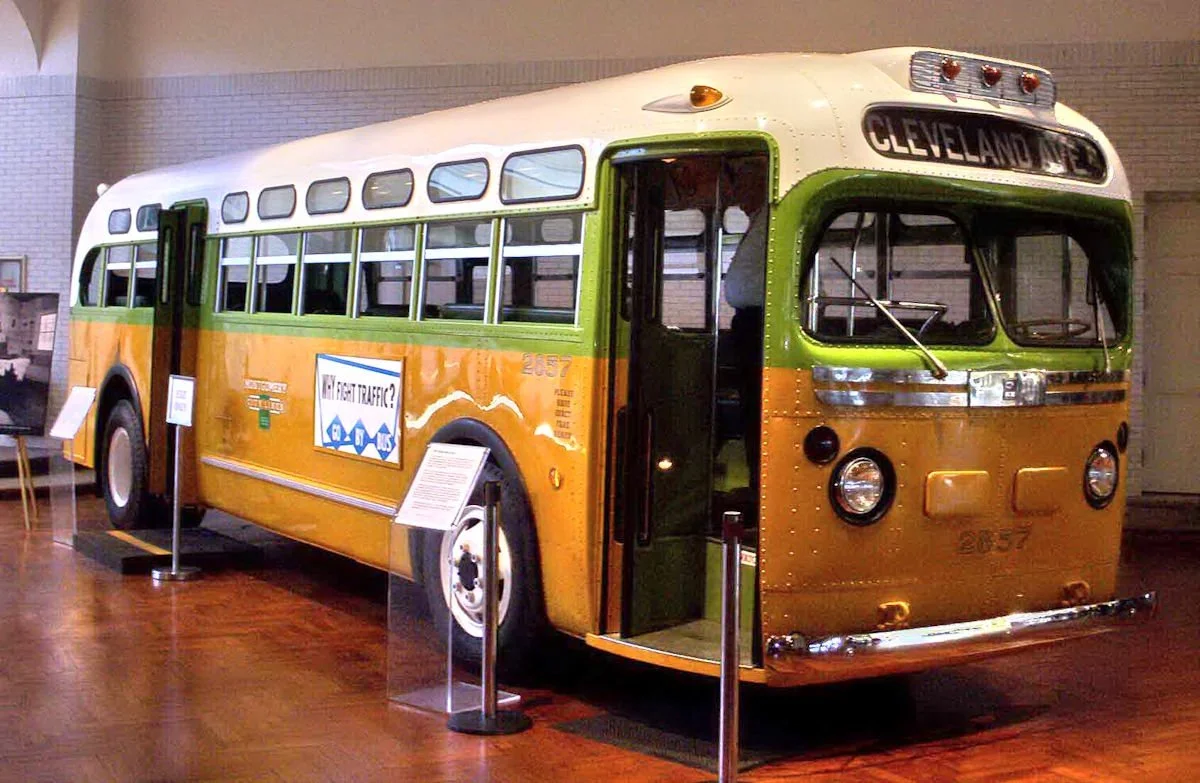
This is the bus Rosa Parks was riding when she refused to give up her seat. It is now on display at The Henry Ford museum in Michigan. Photo by Rmhermen / Wikimedia Commons / CC BY-SA 3.0.
Learn More
Watch a biography of Rosa Parks.
Find more resources at Homeschool History.