December 9: Birthday of Douglas Nicholls (1906)
Prayer Idea
Pray for Aboriginal Australians.
History Note
People have lived in Australia for thousands of years. The people whose ancestors lived there long before Europeans arrived are known today as Aboriginal Australians. Aboriginal Australians have diverse cultures and languages.
European ships explored the coast of Australia in the early 1600s, starting with the Dutch and then the English. In 1770 Captain James Cook claimed the east coast of Australia for Britain and named it New South Wales. British settlers formed five other colonies in Australia. On January 1, 1901, the six separate colonies joined together to become the Commonwealth of Australia.
During the 1800s and early 1900s, the government of Australia set up reserves or stations for Aboriginal Australians. The government provided food and sometimes housing and education. Churches also established missions that provided similar help. However, a majority of Aboriginal Australians continued to live outside of the reserves.
Some government leaders wanted Aboriginal Australians to assimilate into white society. One way they attempted to do this was by taking Aboriginal children, particularly girls, away from their families. These children grew up in institutions or with white families so they could learn the English language and way of life. Since many white Australians looked down on all Aboriginal Australians, even those who had been “assimilated” often were not welcome in the larger society.
Douglas Nicholls was born on December 9, 1906, at the Cummeragunja mission in New South Wales, the fifth child in his family. His parents were Herbert and Florence. Their family was part of the Yorta Yorta people. Officials forced his 16-year-old sister Hilda to leave the family when Douglas was eight years old. Douglas remembered in particular the pain it brought his mother.
Douglas received limited formal education, but his parents and community gave him a good foundation for life. He started working at age 14 and also began competing in sports.
Nicholls was relatively short (5 feet, 2 inches), but he was strong and fast. Nicholls won running competitions but became best known as an Australian football player. He competed for several years as the only Aboriginal player in the Victorian Football Association. He was twice recognized as the “best and fairest” player.
Nicholls grew up attending church, but he drifted away as a young man. After his mother died in 1932, he returned to his spiritual roots and committed his life to Christ. He remained open about his faith while he was an athlete and throughout his life.
The year 1938 marked 150 years since the first British settlers arrived in 1788. Citizens planned great celebrations for January 26, a date that had become known as Australia Day.
William Cooper was a prominent Aboriginal leader who sought equal rights for Aboriginal Australians. Douglas Nicholls was one of his great-nephews. William Cooper led an organization called the Australian Aborigines League. Nicholls joined this movement to change the way the Australian government treated Aboriginal Australians.
The Australian Aborigines League joined with another organization called the Aborigines Progressive Association to hold their own event on January 26, 1938. Instead of a day of celebration, however, the Aboriginal Australians called it a Day of Mourning. They wanted to protest 150 years of mistreatment by white Australians.
The Day of Mourning began with a march through Sydney. Some non-Aboriginal Australians supported their efforts. About 100 Aboriginal Australians met at the Australian Hall to make a public appeal for equal treatment. Several people, including Douglas Nicholls, made speeches at the event. The tradition of holding a Day of Mourning on Australia Day has continued every year since then.
Douglas Nicholls became a prominent figure in Australia through his humble and determined leadership. He was a spiritual leader, serving as a preacher and pastor. He was a cultural leader who encouraged Aboriginal Australians to pursue excellence in sports and the arts. Nicholls was also a political leader who encouraged Australians to work together, regardless of their skin color. This is an excerpt from one of his sermons:
And I want to suggest three things why you should bother about the Aborigines. Firstly, we belong to the great family of God and He had made out of one blood all nations of men. Secondly, why you should bother about the Aborigines, we’re a part of the great British Commonwealth of nations. And thirdly, we want to walk with you, we don’t wish to walk alone.
Douglas married Gladys Nicholls in 1942. She was the widow of Douglas’s brother Howard and already had three children. Douglas and Gladys had two more children together.
Nicholls became a Member of the Order of the British Empire (OBE) in 1957 and then an Officer of the OBE in 1968. The British government established these honors during World War I to recognize people who made positive contributions to the British Empire. In 1972 Nicholls traveled to London with his wife to receive knighthood for his “distinguished services to the advancement of the Aboriginal people.” They received the titles of Sir Douglas and Lady Gladys.
On December 1, 1976, Sir Douglas was inaugurated as the appointed Governor of South Australia. He was the first Aboriginal Australian to hold such a position. Nicholls welcomed Queen Elizabeth II on her royal tour in March. Poor health forced him to resign his position soon after.
Lady Gladys died in 1981, and Sir Douglas died in 1988. They were survived by children and grandchildren who cherished their memory and by thousands of Australians who appreciated their service over many decades.
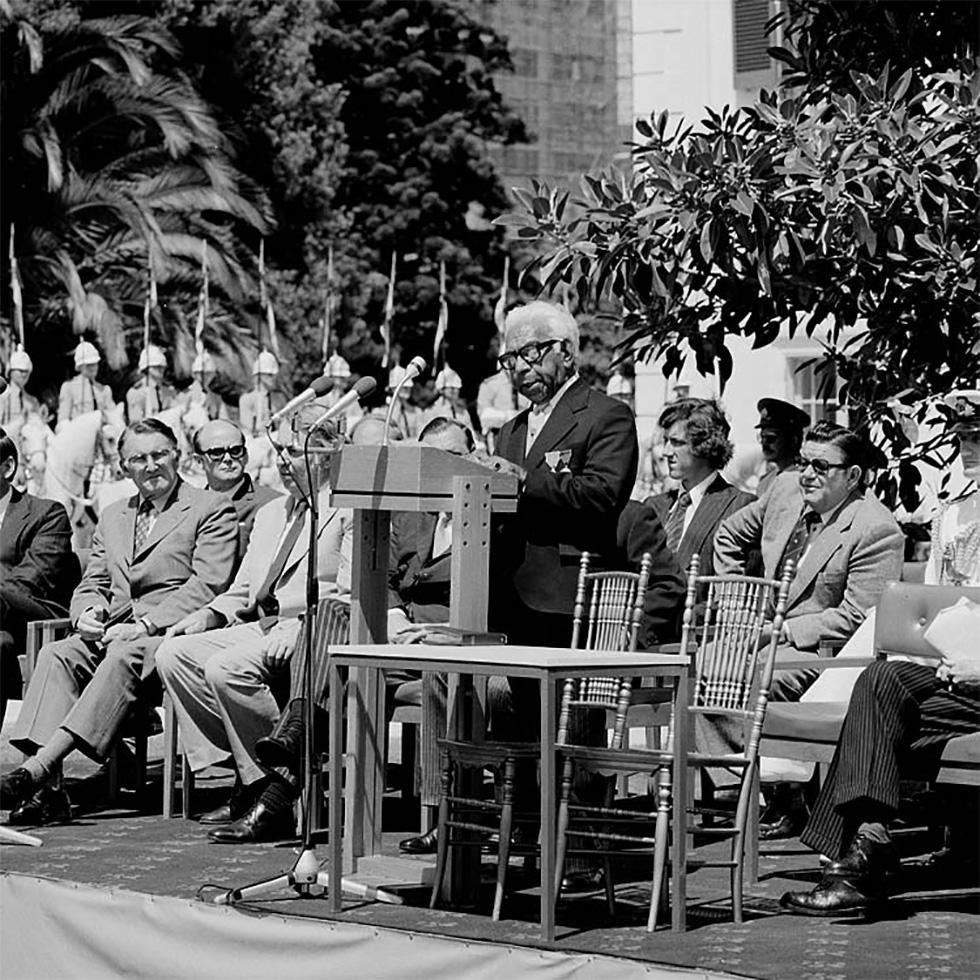
This image shows Sir Douglas Nicholls at the ceremony installing him as Governor of South Australia. Image by the Australian Information Service, Canberra, courtesy the National Archives of Australia.
Learn More
See images and video of Douglas Nicholls in this biography.
Find more resources at Homeschool History.