December 10: First Nobel Prizes Awarded (1901)
Prayer Idea
Pray for the members of the Nobel Prize committees as they seek to recognize and honor the work of others.
History Note
Alfred Nobel was born in 1833 in Stockholm, Sweden. His father, Immanuel, was an inventor and engineer who found success working in Russia. His mother, Caroline, encouraged Alfred’s childhood curiosity.
The Nobel family settled in Russia in 1842, and Alfred learned from private tutors. He took a special interest in chemistry. He also became fluent in English, French, German, and Russian (in addition to Swedish).
Alfred Nobel began experimenting with explosives, used particularly in mining. Nitroglycerin was an explosive compound discovered in the 1840s. In the 1860s, Nobel developed a way to make detonating nitroglycerin safer. However, the substance was still dangerous. Nobel’s own factory blew up in 1864, killing Nobel’s brother, Emil, and several others.
Nobel created dynamite in 1867. Dynamite had the explosive power of nitroglycerin, but it was much safer to handle and transport. Dynamite quickly found use in the construction of roads, railroads, tunnels, and canals. It also became a component of weapons used to kill people and destroy things.
Throughout his life, Nobel traveled extensively for business. He wrote plays, novels, and poems, but most of his work remained unpublished during his lifetime. He never married.
His businesses made Alfred Nobel a very wealthy man. After he died in 1896, people examined his four-page will. He instructed that the bulk of his fortune should be put into a trust fund. The interest from the fund was to be distributed as prizes to people who “conferred the greatest benefit to humankind.” He specified five recipients who should receive prizes each year:
the person who made the most important discovery or invention in the field of physics
the person who made the most important chemical discovery or improvement
the person who made the most important discovery within the domain of physiology or medicine
the person who, in the field of literature, produced the most outstanding work in an ideal direction
the person who has done the most or best to advance fellowship among nations, the abolition or reduction of standing armies, and the establishment and promotion of peace congresses
Nobel added: “It is my express wish that when awarding the prizes, no consideration be given to nationality, but that the prize be awarded to the worthiest person, whether or not they are Scandinavian.”
The first Nobel Prize ceremonies were held on December 10, 1901. Stockholm hosted the ceremony announcing the prizes in physics, chemistry, physiology or medicine, and literature. A meeting of the Norwegian Storting (parliament) in Oslo, Norway, announced the two winners of the peace prize.
These were the first recipients:
Physics: Wilhelm Conrad Röntgen for “the discovery of the remarkable rays subsequently named after him” (also known as x-rays).
Chemistry: Jacobus H. van ‘t Hoff for “the discovery of the laws of chemical dynamics and osmotic pressure in solutions.”
Medicine: Emil von Behring for “work on serum therapy, especially its application against diphtheria.”
Literature: Sully Prudhomme “in special recognition of his poetic composition, which gives evidence of lofty idealism, artistic perfection and a rare combination of the qualities of both heart and intellect.”
Peace: Henry Dunant for “humanitarian efforts to help wounded soldiers and create international understanding” and Frédéric Passy for “lifelong work for international peace conferences, diplomacy and arbitration.”
The Nobel Foundation continues to oversee the awarding of Nobel Prizes each year on December 10, the anniversary of Nobel’s death.
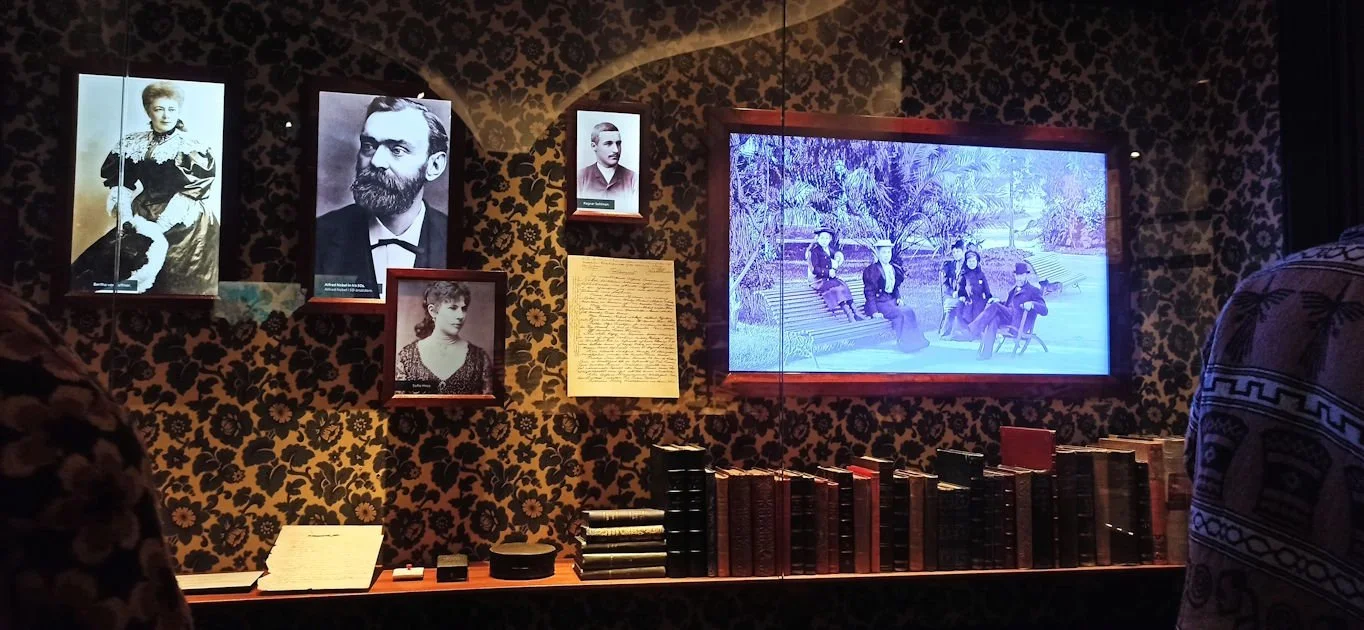
The Nobel Prize Museum in Stockholm, Sweden. Photo by Andi Berdica / Shutterstock.com.
Learn More
See images of the first Nobel Prize recipients.
Find more resources at Homeschool History.