December 11: Georges Claude Debuts a Neon Light (1910)
Prayer Idea
Pray for people who work in advertising.
History Note
In ancient times, business owners used signs outside their businesses to draw attention to them. This practice continued in the Middle Ages. Since most people could not read, businesses used a variety of images and symbols on their signs to stand out.
The development of electric signs in the 1880s meant that businesses could continue to advertise after dark. Georges Claude (1870-1960) was a French engineer and chemist who developed an artistic and attractive form of signage.
Other scientists had discovered that certain gases would glow when electricity was passed through them. Claude expanded on their research. He built glass tubes filled with the gas neon that could glow orange-red for hundreds of hours.
At the Paris Motor Show in December of 1910, Georges Claude demonstrated his neon light. Claude’s invention was not practical for illuminating homes and offices, though it led to the later development of fluorescent lighting. People soon saw the potential for neon lights in advertising, however. A barbershop in Paris installed the first neon sign in 1912.
Claudes experimented with other gases to produce different colors, though “neon” stuck as the common name for the illuminated tubes of gas. His technology soon spread to other countries, including the United States.
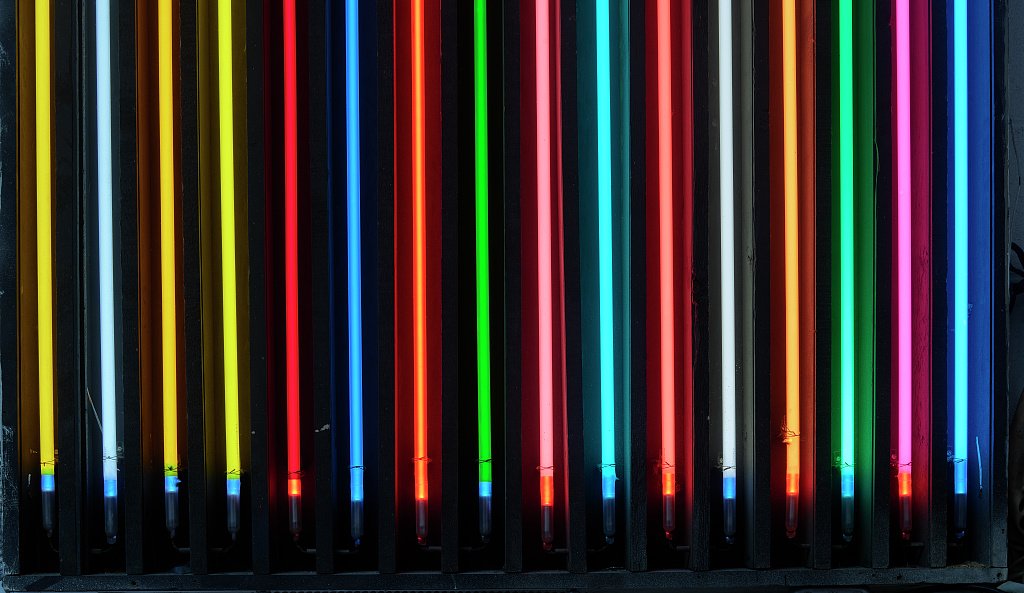
The Ace Sign Company was established in Springfield, Illinois, in 1940, and the company is home to a sign museum. This image shows different colors of neon lights there. Image courtesy the Carol M. Highsmith's America Project in the Carol M. Highsmith Archive, Library of Congress.
Learn More
In this 360° animation, explore the colorful world of neon signs and learn what makes them glow.
Find more resources at Homeschool History.